Best Vacuum Sealers Guide
Chamber Sealers · Buying Guide

A chamber sealer lowers the whole room around the bag, not the bag itself.

An external sealer pulls air out through the open mouth of a bag, so anything loose and wet — broth, marinade, a sauce — gets pulled toward the heat strip before it closes. A chamber sealer puts the entire pouch inside a sealed box and drops the pressure around it, bag and all, so there is nowhere for liquid to travel. That single difference in mechanism is why chamber machines exist, and why their price, weight and counter footprint are all so much larger than a countertop sealer’s. We compared six chamber sealers on published seal-bar length, chamber capacity, pump and cycle disclosures, and price, to find which one earns the space it takes up.

By Ilane Tall · Updated November 29, 2026 · Research-based.6 chamber sealers comparedNo testing lab, no invented scores

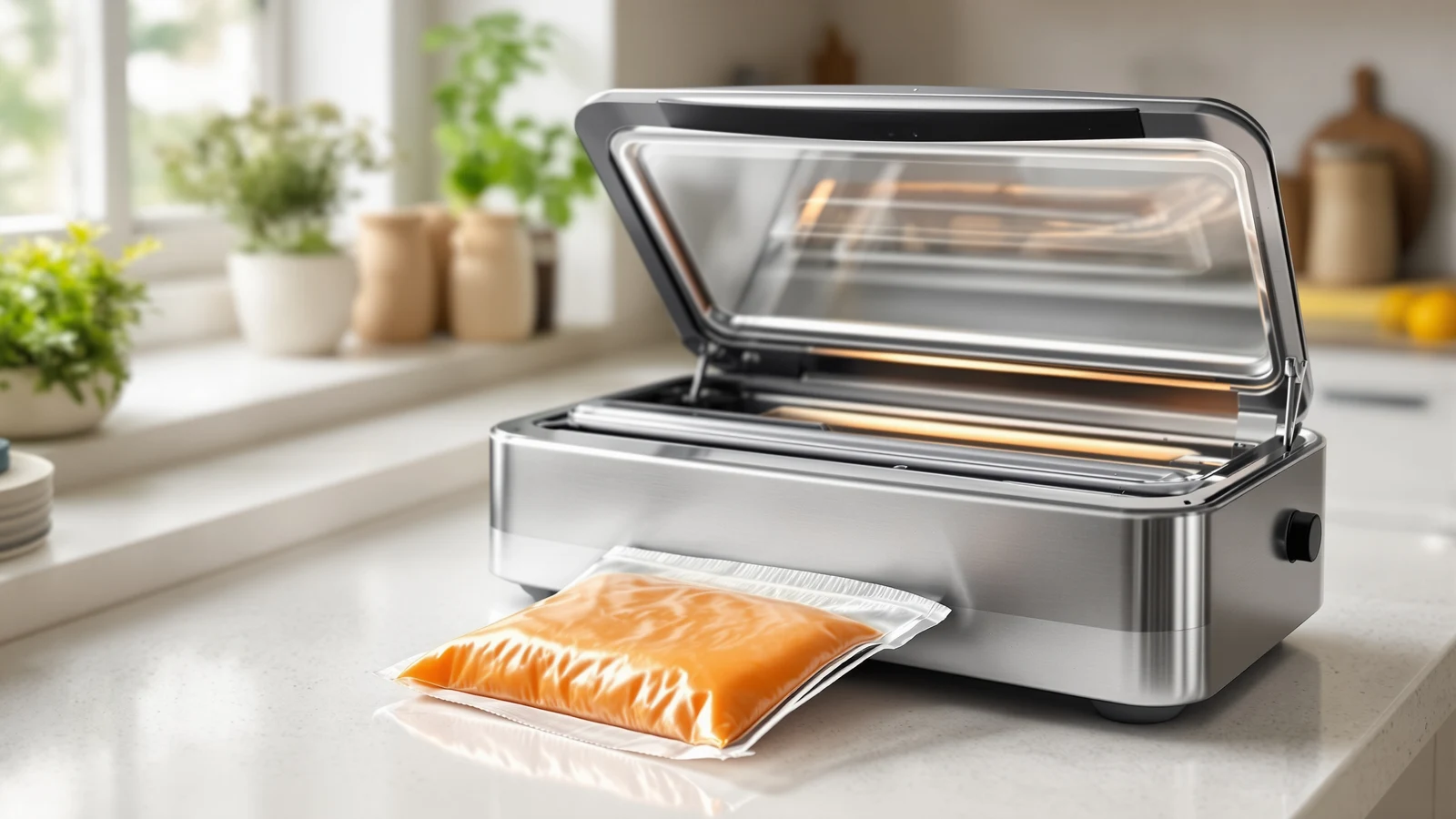
Stainless steel chamber vacuum sealer with its glass lid open over a clear pouch of liquid on a kitchen counter

Affiliate disclosure: we may earn a commission if you buy through the Amazon links on this page, at no added cost to you. Prices and specifications are pulled from the product listings and can change after publication — the listing is always the authority, not this page.

Quick answer

If you only read one paragraph

Buy a chamber sealer only if you regularly seal liquids, marinate in bulk, or process enough meat that smooth, cheaper pouches start to matter. For most kitchens that means the Vesta Precision V513 ($319.00): a 12-inch seal bar, a detachable and washable chamber, a commercial pump and an Auto Vacuum Time setting that takes the guesswork out of the cycle. Tighter on budget, the Avid Armor USVX ($279.00) is the cheapest way into chamber sealing with a 10-inch dual-wire bar built specifically for soups and sauces. If you only seal the occasional bag of raw meat or berries, skip this whole category and read our main vacuum sealer guide instead — an external sealer will do the job for a fraction of the price and counter space.

Before you buy

Four things to check before you commit counter space to one of these

01

It's a box, not a clamp

Every chamber sealer here works the same way: the whole bag goes inside a sealed chamber, the lid closes, and a pump drops the pressure around the entire pouch at once instead of sucking air out through one open end.

02

Seal bar = widest bag

The length of the heat strip is the widest pouch the machine can close flat. Across these six it runs from 10 to 12 inches — shorter than you'd expect for machines this much larger than a countertop sealer.

03

Bags get cheaper, not more flexible

Chamber machines run on smooth pouches, which cost less per bag than the embossed bags an external sealer needs. Several of these include a starter pack of bags, rolls or jar lids in the box.

04

Few listings publish pump type

Only one of the six machines we compared states its pump type in plain language. Everything else is inferred from seal bar, chamber size and price — treat gaps in the spec sheet as gaps, not features.

The mechanism

How a chamber sealer keeps liquid in the bag

An external, or countertop, sealer clamps the open end of a bag and draws air out through that opening with a hose or a direct vacuum port. For dry, solid food that works fine: the air leaves, the bag collapses, the heat strip closes the seam. The moment there is loose liquid in the bag — soup, brine, a thin marinade — the pressure drop pulls that liquid toward the open end, because that is the only path the air has to escape. Get the mix wrong and the liquid reaches the heat strip before it closes, ruining the seal or spilling into the machine.

A chamber sealer removes that path entirely. The bag goes inside a sealed box with the lid closed, and the pump draws air out of the whole chamber — around the bag, not through it. Because pressure drops evenly on every surface of the pouch at once, there is no gradient pulling liquid toward an opening. Gasbye’s listing describes the result as balanced pressure inside and outside the bag, the plain-language version of the same physics: the bag seals closed while the liquid sits wherever you put it.

This is also why chamber machines run on plain, smooth pouches instead of the textured bags an external sealer needs. A textured bag has channels along one side so trapped air can travel toward the opening before the seal closes; a chamber sealer never needs those channels because air is pulled off every surface directly. Smooth bags cost less — one of the few running-cost advantages a chamber machine has over the cheaper countertop alternative.

The numbers that matter

Seal bar, chamber size and the largest pouch each one takes

The seal bar is the ceiling on bag width, full stop. Across these six it runs narrower than you might expect given the size of the machines themselves: the Avid Armor USVX lists a 10-inch dual-wire bar, the VEVOR an 11-inch bar, the Mesliese an 11.3-inch dual sealing bar, Gasbye a replaceable 11.5-inch bar with a double seal, the Avid Armor USV32 an 11.5-inch commercial dual-wire bar, and the Vesta Precision V513 the longest at 12 inches. None states a maximum pouch length separately from the bar, so the chamber’s internal footprint is the other number worth checking.

Chamber capacity is published for three of the six. The Mesliese lists a 6.3-quart (6-liter) chamber, the largest figure here, paired with its 11.3-inch bar and a built-in cutter. The Vesta Precision V513 lists a 5.6-quart chamber with a detachable, washable design. Gasbye lists a 5.3-quart chamber on its 11.5-inch bar. The USVX, the VEVOR and the USV32 don't publish a capacity figure, so we're not assigning one.

Two listings go further and give overall machine dimensions: the VEVOR at 13.5 by 12.2 by 10 inches, the Mesliese at 13.98 by 15.69 by 9.02 inches. Those describe the counter footprint, not usable chamber space, but they're the closest thing to a size guarantee before the box arrives. The other four listings don't publish dimensions at all, so confirm counter clearance on the listing before ordering.

What runs the vacuum

Pumps, cycle control and what each listing actually discloses

This is the category where chamber sealer listings are least forthcoming, and we'd rather say that plainly than guess. The Vesta Precision V513 is the only one of the six that names its pump outright, describing it as a commercial pump, paired with an Auto Vacuum Time setting that sets the cycle length automatically. The Mesliese publishes a target pressure of 100 kPa and a dedicated Quick Marinate mode alongside an external vacuum port for canisters — the most cycle-level detail among the rest.

The Avid Armor USVX and USV32 both describe their bars as commercial dual-wire, which speaks to the seal rather than the pump; neither states a pump type or vacuum figure. VEVOR and Gasbye likewise publish no pump specifications; Gasbye's listing instead emphasizes its double seal — two parallel heat lines, a seal-integrity feature, not a pump one. If a named pump type or duty cycle matters, the Vesta and the Mesliese are the two listings that tell you something concrete; treat the other four as unstated rather than assume they match a competitor's spec.

Living with one

Weight, footprint, and where a chamber machine actually lives

None of the six listings publishes a weight figure, worth saying outright rather than estimating one: a chamber sealer is a steel box built around a pump and a sealed lid, meaningfully heavier than a countertop sealer, but we won't put a number on it that isn't on the listing. The two listings that do publish dimensions — the VEVOR at 13.5 by 12.2 by 10 inches, the Mesliese at roughly 14 by 15.7 by 9 inches — both describe a machine that wants a permanent spot, not one moved on and off a shelf before and after each use.

That permanence is part of the trade a chamber sealer asks you to make. Vesta Precision addresses cleanup directly: the V513's chamber detaches and the seal bar is washable, which matters more on a machine that lives in one spot and processes meat juice regularly. If your kitchen has no dedicated spot for an appliance this size, that's a real constraint before price even enters the conversation — measure counter or cart space against whichever listing's footprint you're considering, not the photo.

Side by side

The six, compared

SealerBest forSeal barChamberPump / cyclePriceGet it
Vesta Precision V513 Most kitchens 12 in 5.6 Qt, detachable Commercial pump, Auto Vacuum Time $319.00 Get it
Avid Armor USVX Lowest entry price 10 in, dual wire Not listed Not listed $279.00 Get it
Mesliese 100kPa Largest chamber, bulk liquids 11.3 in, dual 6.3 Qt / 6 L 100 kPa target, Quick Marinate $294.48 Get it
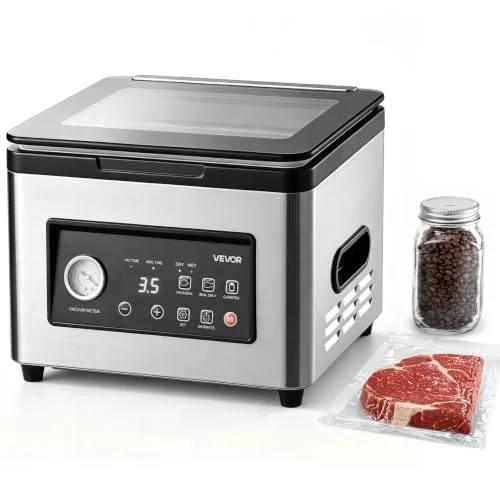
VEVOR Chamber Sealer Jars and bags included 11 in Not listed Not listed $283.90 Get it
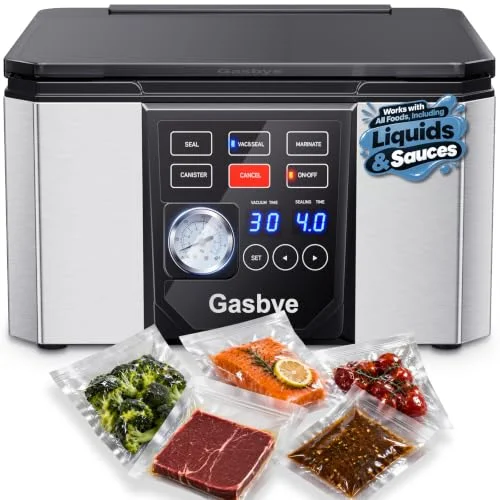
Gasbye Chamber Sealer Double-seal durability 11.5 in, double seal 5.3 Qt Not listed $319.99 Get it
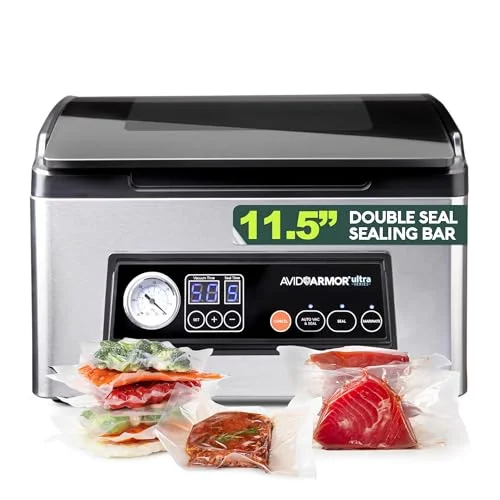
Avid Armor USV32 Premium / commercial 11.5 in, dual wire Not listed Not listed $529.00 Get it
The six

Our picks, and who each one is for

01Best overall

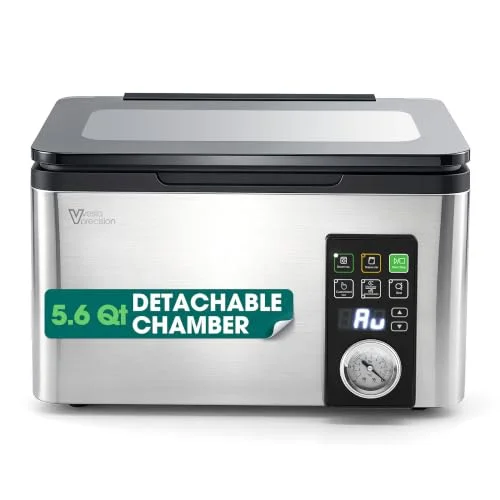
Vesta Precision 12” Chamber Vacuum Sealer, V513

Best for most home kitchens that seal liquids regularly

12-inch seal bar·5.6 Qt detachable chamber·Commercial pump·Auto Vacuum Time

The V513 is the only machine here that names its pump outright — a commercial pump — backed by an Auto Vacuum Time setting that controls cycle length automatically. The chamber detaches for cleaning and the seal bar is washable, which matters on a machine that handles meat juice regularly. At 12 inches, its seal bar is the longest here, and Vesta includes a Mason Jar Kit for canister-style sealing of dry goods and liquids in glass. The chamber is called deep and built for liquids and meats, but no overall footprint or weight is published — measure against the 5.6-quart capacity instead.

The pick that tells you the most about how it actually runs — which is exactly what you want from the machine you’re giving permanent counter space to.

Vesta Precision V513 chamber vacuum sealer with detachable chamber
Price
$319.00
Check price →
02Lowest entry price

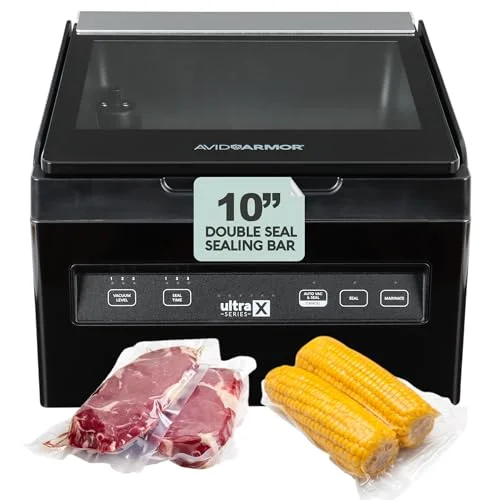
Avid Armor USVX Chamber Vacuum Sealer

Best for a first chamber sealer built around liquids

10-inch dual-wire bar·Compact chamber body·Lowest price of the six

The USVX is Avid Armor's entry point into chamber sealing, and at $279.00 it undercuts every other machine here while staying purpose-built for the job: the listing calls out soups, marinades and sauces sealed without mess, alongside sous vide prep and bulk storage. Its 10-inch dual-wire bar is the shortest of the six, capping the widest pouch it can close. No chamber capacity, pump type or overall dimensions are published, so confirm fit and bag size on the listing before buying.

The way into chamber sealing if the only thing pushing you there is liquid, and the rest of the feature list is secondary.

Avid Armor USVX compact chamber vacuum sealer for wet foods
Price
$279.00
Check price →
03Largest chamber

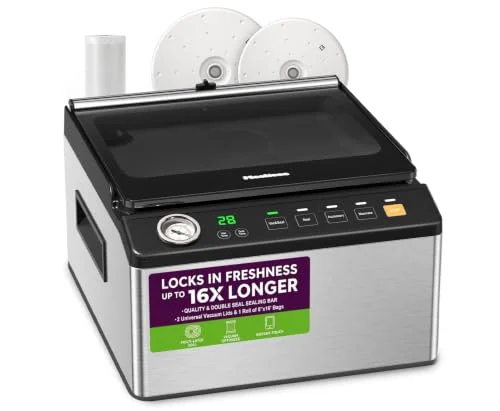
Mesliese 100kPa Chamber Vacuum Sealer, 6.3QT

Best for bulk liquids and large batches

6.3 Qt / 6 L chamber·11.3-inch dual sealing bar·Built-in cutter·External vacuum port

Of the three listings that publish a chamber capacity, the Mesliese states the largest: 6.3 quarts, or 6 liters, the most interior room for sealing several pouches of soup in one session. It pairs that with an 11.3-inch dual sealing bar, a built-in cutter for making bags to length, and an external vacuum port for canisters alongside the standard chamber function. Mesliese also lists a target pressure of 100 kPa, plus a Quick Marinate mode. Overall dimensions run 13.98 by 15.69 by 9.02 inches — the largest footprint here that actually discloses one.

The one to reach for if you’re portioning a whole pot of stock in one sitting rather than a single pouch at a time.

Mesliese 100kPa chamber vacuum sealer with 6.3 quart capacity
Price
$294.48
Check price →
04Best bundle

VEVOR Chamber Vacuum Sealer, 11” Seal Bar

Best for stocking up on jars and bags on day one

11-inch seal bar·13.5 x 12.2 x 10 in·Mason jar lids included·60 vacuum bags included

VEVOR markets this chamber sealer for home and restaurant use, covering meat marinating, sous vide and liquid storage with an 11-inch seal bar. What sets the listing apart is what's in the box: Mason jar lids plus 60 vacuum bags to start the day it arrives — a real saving over buying bags separately. It also gives a full footprint, 13.5 by 12.2 by 10 inches, one of only two here to publish dimensions. No chamber capacity or pump type is stated, so treat those as unlisted.

The pick if you’d rather not make a separate bag-and-jar-lid order the same week the machine arrives.

VEVOR chamber vacuum sealer with Mason jar lids and vacuum bags
Price
$283.90
Check price →
05Best for durability

Gasbye Chamber Vacuum Sealer, 5.3QT

Best for frequent use on a stainless body

5.3 Qt chamber·11.5-inch replaceable bar·Double seal·Stainless steel, 30 bags included

Gasbye builds the chamber to 5.3 quarts and pairs it with an 11.5-inch bar the listing describes as replaceable — a direct answer to heat strips wearing out before anything else on a machine used often. The bar lays a double seal, two parallel heat lines instead of one, pitched for meats, soups, sauces and liquids. The body is stainless steel, easier to keep clean, and 30 pre-cut bags are included. No pump type, cycle settings or dimensions are stated, so confirm fit on the listing.

A straightforward case for stainless steel and a replaceable bar on a machine you expect to run often.

Gasbye stainless steel chamber vacuum sealer with double seal bar
Price
$319.99
Check price →
06Premium pick

Avid Armor USV32 Chamber Vacuum Sealer

Best for a full-view lid and the longest commercial-grade bar in the lineup's premium tier

11.5-inch commercial dual-wire bar·Glass lid·Highest price of the six

The USV32 sits at the top of Avid Armor's own range, priced well above its sibling the USVX, and the listing frames it as a premium sealer built around a glass lid, so you can watch the cycle rather than sealing blind. The 11.5-inch bar is commercial dual-wire, matching the Gasbye's length and sitting just under the Vesta's 12 inches. No chamber capacity, pump type, cycle settings or dimensions are stated — at this price, we'd expect more disclosed. Buy this one for the glass lid and the brand, not a fuller spec sheet.

The glass lid is a genuine, visible upgrade. The rest of the case for paying nearly double has to come from trusting the brand, not the listing.

Avid Armor USV32 premium chamber vacuum sealer with glass lid
Price
$529.00
Check price →
The other path

Who should stay with an external sealer

A chamber sealer solves one problem completely — liquid reaching the seal before it closes — and asks for real money and counter space in return. If that problem comes up only occasionally, a countertop sealer remains the better buy: dry goods, steaks, chicken breasts and freezer produce need none of what a chamber machine adds. Our main vacuum sealer guide compares the countertop and handheld options built for exactly that everyday sealing, including models with a dedicated liquid mode for juicy meat and thin marinades without a chamber at all.

Occasional liquid is also manageable without one: freeze soup, stock or sauce flat until solid, then vacuum seal the frozen block on an external sealer exactly as you would a steak. It's an extra step, but it sidesteps the core problem instead of fighting it — the honest answer for anyone eyeing a $279-to-$529 machine to seal a pot of soup twice a year. Reach for a chamber sealer only once you can point to a recurring reason: weekly stock, regular sous vide marinating, or enough bulk meat that smooth, cheaper bags start to add up.

Our method

How we compared — and what we can’t tell you

What we did

Listings, specs and current prices

We compared published listing text, specifications and current Amazon prices for six chamber vacuum sealers, tying every claim about seal-bar length, chamber capacity, pump type and accessories to what each listing states. Where a listing didn't publish a figure — a weight, a dimension, a pump type — we said so rather than filling the gap with a guess. For more on our approach, see our About page.

What we didn’t

We do not physically test these machines

We do not own these sealers, run a lab, or physically test them against each other. We also have no verified rating or review data for this category, so this page publishes no ratings, review counts or paraphrased owner sentiment — only specifications, prices and the general physics of how a vacuum chamber behaves. If a price, spec or listing detail has changed, contact us and we'll correct it.

FAQ

Common questions about chamber vacuum sealers

What's the real difference between a chamber and an external vacuum sealer?

An external sealer clamps the open end of a bag and pulls air out through that opening, so liquid inside gets drawn toward the heat strip as the air leaves. A chamber sealer puts the entire bag inside a sealed box and drops the pressure around the whole pouch at once, so there's no gradient pulling liquid anywhere. That's why chamber machines are the design of choice for soups, marinades and sauces, and why they cost and weigh more than a countertop sealer.

Can a chamber vacuum sealer handle soup and other thin liquids?

Yes — that's the problem a chamber sealer is built to solve. Because the vacuum pulls evenly on every surface rather than through one open end, thin liquids like soup, stock and brine stay where you put them instead of racing toward the seal. The Avid Armor USVX listing specifically calls out soups, marinades and sauces sealed without mess, and other listings here make the same claim for liquid foods generally.

Do chamber vacuum sealers need special bags?

No — that's one of their advantages. Chamber sealers run on smooth pouches rather than the textured bags an external sealer requires, because the vacuum pulls around the bag rather than through it, so there's no need for channels that let trapped air escape toward an opening. Smooth bags generally cost less per pouch, and several listings here, including the VEVOR and the Gasbye, include a starter supply of bags or jar lids in the box.

How much counter space does a chamber vacuum sealer need?

More than a countertop sealer, and most listings don't make it easy to plan for. Of the six compared here, only the VEVOR (13.5 x 12.2 x 10 in) and the Mesliese (about 14 x 15.7 x 9 in) publish overall dimensions; the rest state no footprint or weight. Since these machines live in one spot rather than get put away, measure your available space against whichever listing's numbers you can find before you buy.

Keep reading

More from Best Vacuum Sealers Guide